

Rian Oberholzer acknowledges concerns over doping in South African rugby as the union looks at workshops and increased testing initiatives
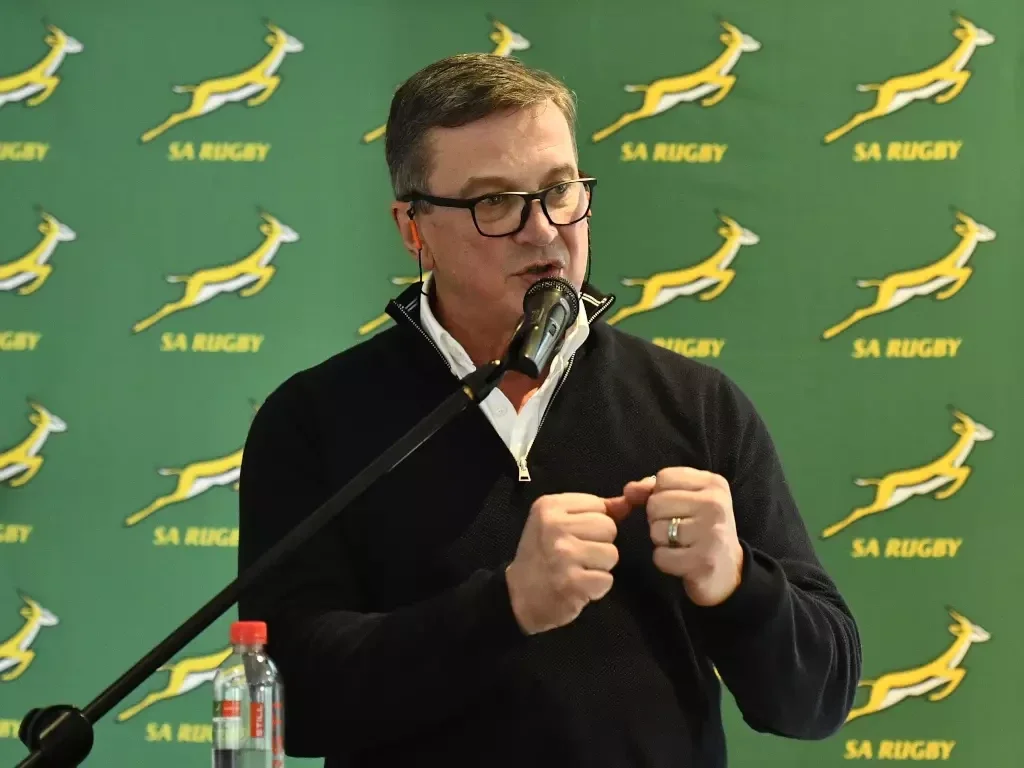
Image: SABC Sport. South African Rugby Union (SA Rugby) CEO Rian Oberholzer.
South African Rugby Union (SA Rugby) CEO Rian Oberholzer has acknowledged growing concerns around doping in South African rugby, but says the organisation faces limitations when it comes to testing schoolboy players.
Doping has once again become a talking point in South African rugby following a number of positive tests involving players this year. One of the most prominent cases is that of former SA Schools and SA Under-20 player Kai Pratt, who was also involved in the Springboks’ alignment camp this year.
Pratt has requested that his B sample be tested, with the outcome potentially providing further clarity on his case.
The growing number of positive tests has also prompted questions from the rugby public over whether South Africa has a wider doping problem or whether other countries simply do not publicise their cases to the same extent.
Oberholzer says the fact that players are being caught should also be viewed as evidence that testing is taking place.
“It is an easy stick to hit us with [saying SA Rugby has a doping issue]. The fact there are positive tests shows we test the players. It is easy to make accusations, but the reality needs to be taken into account as well.”
However, the SA Rugby CEO says testing at school level presents a different challenge because schools fall under the Department of Basic Education and parental consent is required before minors can be tested.
“At schoolboy level we cannot test the players, as the area falls under the Department of Education.”
Oberholzer explained that SA Rugby does conduct testing during the annual Craven Week.
“We can only test at Craven Week and we do that.”
He added:
“You can’t test a kid at school level without the consent of their parents.”
SA Rugby Looks To Education And Workshops
With doping concerns continuing to grow, SA Rugby is considering educational workshops as part of a broader strategy to address the use of prohibited substances in rugby.
Oberholzer also highlighted an initiative involving two Cape Town schools, Rondebosch Boys’ High School and Bishops Diocesan College, ahead of their traditional Bish-Bosch derby.
The schools have agreed to test players before the fixture, with the initiative potentially providing a model for other schools to follow.
“We are planning to do that [do workshops], and there is also a great initiative by two Cape schools that I have only gotten to be aware of now where both headmasters agreed that the players will be tested before the Bish-Bosch [derby] clash.”
Oberholzer believes similar agreements between schools could help address the issue at grassroots level.
“If a school starts doing this, between themselves and agreed… that will also help to address the challenge we currently face.”
However, participation would not be compulsory.
“If you as a player or parent don’t give permission to that, then that is okay. We will not pick the player.”
Cost A Major Consideration
While SA Rugby wants to strengthen its approach to doping education and testing, Oberholzer admits that increased testing comes with a significant financial cost.
“Look, it is also expensive as well.”
The comments come as South African rugby continues to grapple with the balance between protecting the integrity of the sport, educating young players about the dangers of doping and respecting the legal and parental requirements surrounding the testing of minors.
With schoolboy rugby serving as an important pathway towards provincial and national representation, the debate around doping prevention at youth level is likely to remain a major issue for SA Rugby and schools in the years ahead.
